World's First Car!
EducationVeritasium•528.7K Views
Why This Video Went Viral
This video achieved moderate visibility primarily due to strong early engagement signals.
Content in the "Education" category typically performs well when it triggers
immediate viewer interaction within the first 24–48 hours.
Audience & Engagement Insights
Based on historical trends, videos like this resonate strongly with viewers interested in
education content, particularly audiences who engage through likes
and repeat watches rather than comments alone.
With 18.1K likes relative to 528.7K views,
this video demonstrates above-average engagement efficiency for its category.
Editorial Analysis
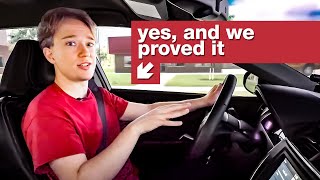
I got to drive the world's first car (replica), patented by Benz in 1886\nCheck out the series on new safety features: http://ve42.co/MB\nThis video is sponsored by Mercedes-Benz, who invited me to come to Stuttgart to see their latest cars, crash test facilities and experience the innovations they are working on.\n\nPhysics is something that is directly applicable to car safety. Cars go fast, but they also sometimes collide with obstacles, which brings them to a sudden stop, subjecting the car and occupants to very high accelerations, which can cause injury or death. So the major idea to improve car safety is to reduce these accelerations and there are a number of ways to do this:\n\nPassive safety:\n\nSeat belts: keep passengers in the vehicle, preventing them from continuing with constant velocity, flying through the windshield and suffering a worse deceleration when they make contact with the road.\n\nCrumple zones: increase the distance over which deceleration occurs, thereby reducing peak magnitude of deceleration.\n\nAir bags: increase the distance over which the head decelerates, again reducing peak magnitude of deceleration of the head.\n\nActive Safety:\nAnti-lock braking system: rather than 'locking' the wheels as can happen if you slam on the brakes with a traditional braking system leading to the tires skidding across the road, ABS attempts to control the amount of braking so that the tires always roll with static friction in contact with the road. This increases the backward frictional force that can be applied to the tires, again increasing the distance over which deceleration occurs, and it gives the driver an opportunity to steer to avoid the collision (hence why it's referred to as an active safety system).\n\nSpecial thanks to Mercedes for having me visit facilities in Stuttgart. I had a lot of fun making these videos so please do check out the series on Mercedes Benz's channel: http://ve42.co/MB\n\nFilmed by Simon Schneider\nEdited by Hoplite Creative and Trevor Carlee
![16 December 2017-The Hindu Editorial News Paper Analysis- [UPSC/SSC/IBPS] Current affairs HD](https://img.youtube.com/vi/_0R5MD6BqGw/mqdefault.jpg)